
Sheepdog Trials in Mazda BT-50
by Peter Brewer
Sheepdog Trials in Mazda BT-50
by Peter Brewer
Meet Scott Smith: Dubbo Sheepdog Trainer and Zoo Keeper
Scott Smith is a genius in working with animals but ask him to knot a necktie and he’s in all sorts, the result looking like it’s been sucked through the intake of a Mazda rotary engine.
And that’s a thorny issue when old-fashioned ties and blazers must be dusted off, and even the work boots given a quick lick, under the required dress code for accepting prizes at the National Sheepdog Trial Championships, because zookeeper Smith regularly scoops up more ribbons and prizes in this canine Olympics than most of the field put together.

It’s curious, too, that animals a tonne or so heavier than his prize-winning pooches are his other specialty. Back home in Dubbo, he’s the black rhinoceros keeper at the huge Western Plains Zoo. It sounds like a shaggy dog story, but it’s true.
So how much does his work with the rather intimidating rhinos help when training the world’s smartest canines?
“All animals have different motivations; it’s just understanding them and learning how to use those motivations to get them to do what you want them to do,” he said, adding for clarification that rhinos “aren’t genetically predisposed for obedience”.
Sheepdog Training Techniques: Calmness, Control and Animal Behaviour
Before entering the sheepdog competition ring, Smith’s ritual is to wander off by himself with his canine companion and sit quietly for some minutes in a semi-meditative state.
“You have to keep cool and calm yourself because the dog knows exactly how you are feeling; if you’re stressed in any way, that gets passed through to the dog,” he explains. And with competition as intense and exhausting as what we’ve come to witness at the National Championships, staying calm is not easy.
Smith’s whip-smart Border Collies are the regular stars of the sheepdog trials, winning the competition’s coveted Duke of Gloucester trophy for the past two years and when the sheets were tallied for 2026, finishing a close runner-up.

National Sheepdog Trial Championships in Hall, Canberra
Competitors from across our wide brown land had loaded up their utes and dogs - check Mazda BT-50 payload calculator - and headed to the trendy agrarian hamlet of Hall, just north of Canberra, for the annual national trials this year.
The stars of the show were mostly lean Collies in patched shades of white, black, and brown, all led about by handlers whose wardrobes appear to hold little more than blue jeans, work shirts, elastic-sided boots, moleskins and Akubras, suitably sun bleached and rim-garnished with various grades of sweat staining.

Why the Mazda BT-50 Fits Rural Australia and Sheepdog Trial Life
It should come as no surprise that our Red Earth Metallic Mazda BT-50 dual cab ute, parked nose-in, country-footy style to the showground ringfence, resplendent in its alloy wheels and with techo-niceties such as wireless Apple Carplay, Android Auto and a reversing camera, would look, to a city eye at least, a bit like bringing a Cavoodle to a pit bull fight.
In actual fact, we should have known that these are very much “ute people” and the comfy, luxurious Mazda drew praise and a smattering of envy from passers-by, who were particularly appreciative of the roomy rear seat and useful extras like the hardy protective tub liner. Eager little doggie claws, we’re told, can make an awful mess of a ute’s tub duco.
You can build your Mazda BT-50 to suit your life, on and off the road.

Led about by their handlers (the quality of the dog leads range from random bits of knotted bailing twine to intricate hand-woven braids), the well-behaved four-legged contestants eyeball their rivals with all the “I-got-this” pre-event calm of Gout Gout before a 200-metre final. The temptation to anthropomorphise is overwhelming when you see dogs entering what seems so much like a canine version of the Olympics, but they really do seem to know exactly why they are there.
On the face of it, the rules of the trials present a Herculean task for even these clever and fiercely energetic canines.
Each dog and handler must yard a fresh trio of far less intelligent sheep each time they enter the ring. The logic of the fresh sheep rule is to guarantee an even competition, although given the goldfish-like memory of most Merinos, the effort seems superfluous.

How Sheepdog Trials Work: Rules, Scoring and Working Dog Roles
Every dog and handler combination starts with 100 points and 15 minutes in which to complete the assigned tasks. The D-shaped competition course of pegs, a race and a bridge has rudely defined eight-metre pathways within which the sheep must be contained. Any straying from these boundaries, or missed markers, leads to deducted points.
And as baffling as it sounds, according to the rulebook the judges also give “positive consideration” to the relationship between “where the sheep are, as opposed to where they ought to be”. This could be either a serious criteria or just one of those jokes that country folk like to play on city slickers.


For those who haven’t spent much time on a farm, it’s important to bear in mind that there are both sheep dogs and yard dogs and while the two may look similarly lean and hungry, they perform quite different tasks.
Good breeders know from week-old pups which ones are which, according to 90-year-old farmer and veteran triallist Tony Whitehead from Urana, in the NSW Riverina.
“The yappiest ones generally make the best yard dogs,” he said, watching as one example exuberantly barked, body-bounced and harried around a dozen obstinate ewes up a truck ramp. Yard dogs are like the nightclub bouncers of the canine world and yes, they do love their work.
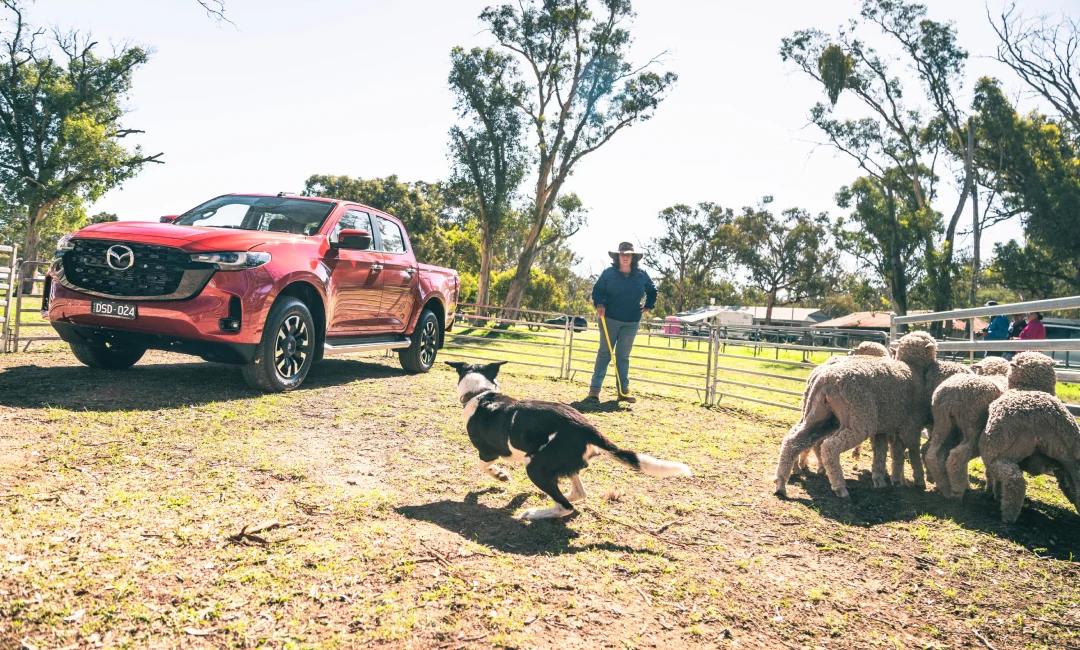
Trialling, however, is far more subtle and serious.
Out in the ring, in the shortest possible time, each competing dog must establish itself as a highly effective, non-threatening control agent, a bit like the operating system on your cellphone.
Should the sheep get spooked, they may – as dumb, nervous sheep so often do – bolt randomly in multiple directions. This blowout both costs competition points and eats into the allotted time as the gathering-up process begins again.
Experienced dogs appear to sense a potential costly flight moment and drop to the ground as if shot, tongues lolling and canine brains feverishly trying to figure out the next effective containment tactic.

This transforms into a creeping slink, then a dart one way and a flat-out bolt the other, always mindful of crossing between the handler and the sheep, which brings instant disqualification.
At first blush, the dog handlers appear to play little or no active role, apart from strolling a defined route around the huge showring, carrying a short wooden baton (waving it, Boston Pops-style, is strictly forbidden) and tooting at intervals on a silent dog whistle.
However, appearances are highly deceptive; the hyper-vigilant dogs are keenly aware of their handlers’ every subtle guiding movement, such as a gentle tilt of the head or a Jedi-like gesture of the hand.

Most competitors bring multiple dogs along to the trial, including their most promising first-timers or “maidens”. Many young dogs are yet to temper their exuberant herding desires and as the competition clock winds down, the volume of the handlers’ exasperated Fred Dagg-like “get in behind”, “stay there” and “get back” commands become steadily louder, much to the amusement of the crowd.
A clang of the yard gate, all three sheep inside, signals the end of each trial, marked by a respectful smattering of applause from the audience and a customary squeeze of the Akubra brim toward the judges’ box.
In sheepdog trials circles, they speak in near-reverential tones of those who have achieved the perfect trial score. Very few have ever lost a single penalty point, but two-time national champion Tony Elliott, from Gundagai, is one. (No-one actually calls him the Nadia Comăneci of sheep dog world, but they should.)
“It’s like winning the lotto jackpot,” he said. “Everything just fell into place that day. Buggered if I know how I pulled it off.”

At night, around the campfire, there are murmured conversations and a camaraderie between contestants, dogs obediently at their feet, gazing into the flames.
It’s little wonder, really, that the Muster Dogs series has been such a smash hit on ABC TV. It’s a world apart from the city’s vacuous social media influencers and their Pilates classes; a place where old-fashioned values, a shared love of dogs, and simple issues like knotting a tie assume a far greater importance.

Enquiry Form
Melville Mazda - Sales
Melville Mazda - Service
Melville Mazda - Parts

Melville Mazda - Sales
- Monday: 8:30am-5:30pm
- Tuesday: 8:30am-5:30pm
- Wednesday: 8:30am-8:00pm
- Thursday: 8:30am-5:30pm
- Friday: 8:30am-5:30pm
- Sat: 8:30am-1:00pm
- Sun: Closed